Published: August 28, 2026
Category: Finance News
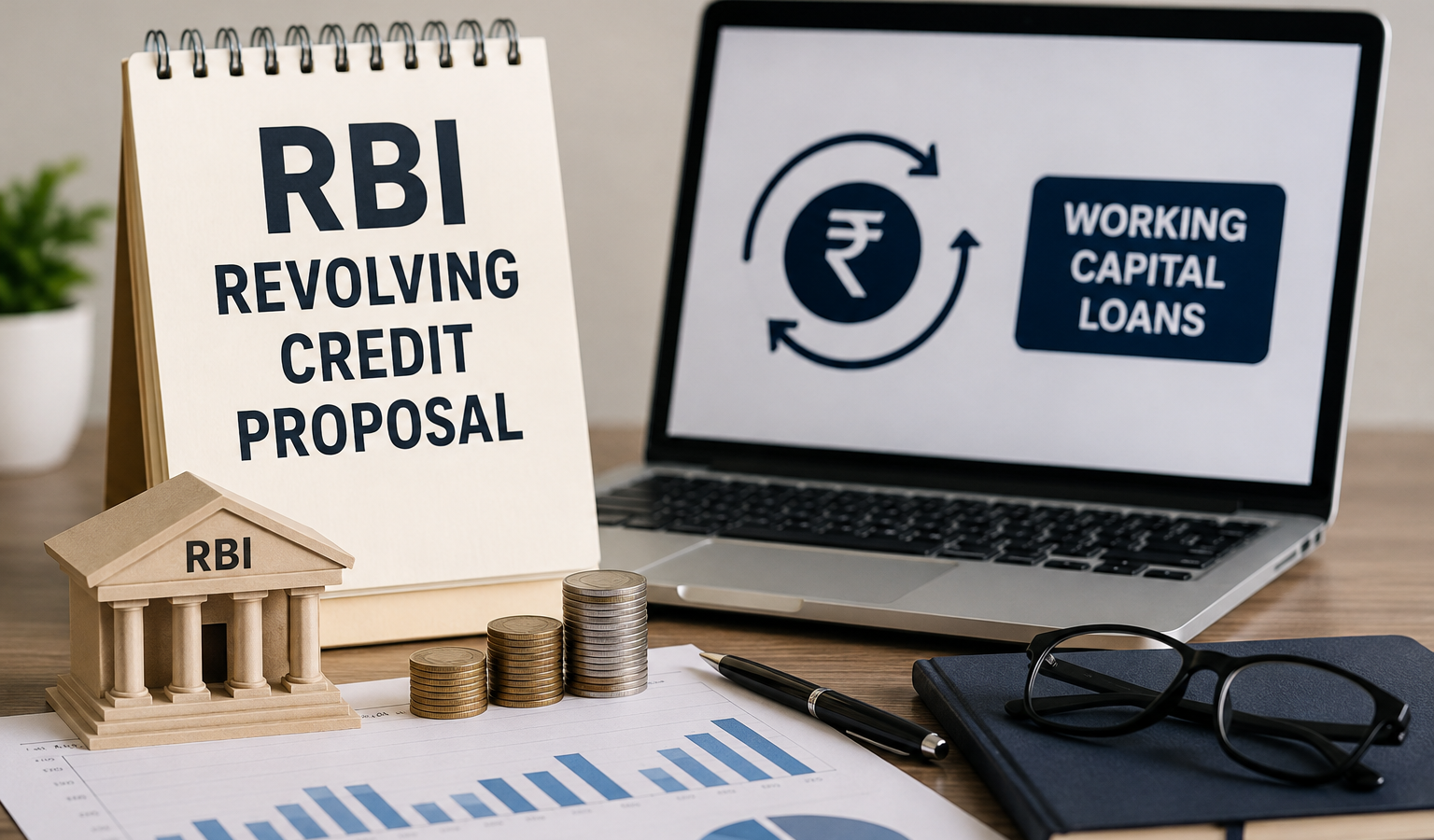
Small businesses that depend on flexible working-capital finance could see changes in how they access credit if the Reserve Bank of India (RBI) moves ahead with its proposed restrictions on revolving credit products offered by non-banking financial companies (NBFCs).
The issue has gained fresh attention after the Finance Industry Development Council (FIDC), which represents NBFCs, urged the RBI to reconsider the proposed restrictions and allow certain limited redraw facilities subject to safeguards.
The RBI’s proposal is part of draft directions issued earlier this month. The consultation deadline for stakeholders is August 28, 2026, so the framework is not yet a final rule.
What Is RBI Proposing?
Under the draft framework, NBFCs would generally be allowed to offer credit products that are structured as term loans, while revolving credit products would be restricted, except for NBFCs authorised to issue credit cards.
A revolving credit facility allows a borrower to:
Draw money → repay it → access the available limit again
A conventional term loan works differently.
Once the loan is disbursed, the borrower follows a predetermined repayment schedule, and repaid principal does not automatically become available for another drawdown under the same facility.
This difference is particularly important for businesses whose cash-flow requirements change from month to month.
Why Are Small Businesses Concerned?
Many small businesses do not receive customer payments immediately.
For example, a manufacturer may need to pay for:
- Raw materials
- Employee salaries
- Transport
- Rent
- Utilities
- Suppliers
But the business may receive payment from customers weeks later.
A flexible working-capital facility can help bridge that temporary gap.
If the business receives money from customers, it can repay the amount used. Under a revolving arrangement, the available limit can potentially be used again when another cash-flow requirement arises.
Industry representatives argue that restricting this flexibility could make working-capital financing more expensive or operationally difficult for some MSMEs.
What Is the Difference Between Revolving Credit and a Term Loan?
The basic difference is how the borrower can access the money.
| Feature | Revolving Credit | Term Loan |
|---|---|---|
| Access to funds | Draw as needed within approved limit | Disbursed according to loan terms |
| Repayment | Can be repaid and potentially redrawn | Repaid according to schedule |
| Flexibility | Higher | Lower |
| Interest cost | Generally linked to amount utilised | Based on loan structure |
| Suitable for | Changing cash-flow needs | Defined borrowing requirement |
| Reuse of repaid amount | Usually possible under the facility | Generally not available automatically |
The exact terms depend on the product and lender.
Why Is the RBI Looking at Revolving Credit?
The RBI’s draft directions are aimed at strengthening the framework governing credit facilities offered by NBFCs.
One concern behind the proposed restrictions is the possibility of borrowers remaining in repeated cycles of borrowing and repayment.
The regulator has also raised concerns around practices that could mask borrower stress or result in loans being effectively rolled over rather than properly resolved.
The draft therefore proposes a clearer distinction between term loans and revolving credit facilities.
The policy objective is to improve responsible lending and reduce the possibility of credit being used in ways that can increase borrower stress.
Why Are NBFCs Asking RBI to Reconsider the Proposal?
The industry argument is that not every revolving facility is the same.
Some facilities are used for productive business activity rather than consumer borrowing.
FIDC has argued that businesses with fluctuating working-capital requirements should be allowed to restore or replenish repaid principal within an existing sanctioned limit, subject to safeguards.
It has also asked the RBI to distinguish between a genuine redraw facility and the renewal or rollover of a loan.
The industry body says a blanket restriction could affect products used for working capital, supply-chain finance and other business financing arrangements.
What Could Happen to Working-Capital Costs?
If flexible revolving facilities are replaced by repeated term loans, businesses may have to apply for additional financing whenever their funding requirement increases.
That could potentially mean:
- More documentation
- Additional credit assessment
- Longer processing times
- More administrative costs
- Higher borrowing costs in some cases
FIDC has specifically argued that forcing businesses to take fresh term loans instead of using limited redraw facilities could increase both interest and operational costs.
However, the actual impact will depend on the final RBI framework and how lenders redesign their products.
Could MSMEs Be Affected More Than Large Companies?
Potentially, yes.
Smaller businesses often operate with thinner cash buffers and may have less predictable payment cycles.
A large company may have multiple sources of funding available. A smaller business may depend more heavily on short-term working-capital facilities to manage the gap between paying suppliers and receiving money from customers.
Industry representatives have therefore argued that the proposed restrictions could have a greater effect on MSMEs that have limited access to traditional bank-based working-capital facilities.
But this does not mean that all MSMEs will lose access to working-capital finance.
The proposal is still under consultation, and the final rules may differ from the draft.
Will Existing Borrowers Immediately Lose Their Credit Limits?
No immediate conclusion should be drawn at this stage.
The RBI document currently under discussion is a draft framework, not a final implementation of a blanket restriction affecting every existing borrower.
The consultation process is underway, and stakeholders have been invited to provide feedback.
Therefore, borrowers should not assume that an existing working-capital facility will automatically disappear because of the proposal.
Any final changes will depend on the directions ultimately issued by the RBI.
What Does This Mean for Small-Business Owners?
For an MSME owner, the most important issue is not the technical definition of revolving credit.
It is access to cash when the business needs it.
Consider a simple example.
A small manufacturer receives an order requiring ₹10 lakh of raw materials.
The business expects customers to pay after 45 days.
The manufacturer therefore needs short-term funding to cover the gap.
With a flexible credit facility, the business may be able to borrow what it needs, repay the amount when customer payments arrive and potentially access the available facility again.
If that flexibility is replaced by separate term loans, the business could face additional borrowing and documentation whenever another funding requirement appears.
The final impact will depend on how the RBI’s rules are ultimately structured.
Could the Proposal Also Affect Individual Borrowers?
The potential impact is not limited to businesses.
Industry representatives have pointed out that several credit products used by individuals could also fall within the broader definitions under discussion.
However, the exact impact will depend on the final regulatory framework and the specific structure of each credit product.
Therefore, borrowers should not assume that every existing flexible loan product will automatically be discontinued.
Why Is the Consultation Important?
The RBI invited comments from regulated entities and other stakeholders on the draft directions up to August 28, 2026.
Feedback from lenders, businesses and other stakeholders can help the regulator identify unintended consequences before final directions are issued.
This is particularly important when a regulatory change affects different types of credit products with very different purposes.
A facility used for short-term productive working capital may have a different risk profile from a product that allows borrowers to continuously roll over consumer debt.
That distinction is one of the main issues raised by industry representatives.
What Should Small Businesses Do Now?
Business owners should not panic or immediately change their existing borrowing arrangements based only on the draft proposal.
Instead, businesses can take a few practical steps.
1. Review Existing Credit Facilities
Understand whether your current facility is a term loan, working-capital facility, overdraft-type arrangement or another form of flexible credit.
2. Check Your Repayment Terms
Know what happens when you repay part of the principal.
3. Measure Your Cash-Flow Gap
Understand how much short-term funding your business actually needs between paying expenses and receiving customer payments.
4. Maintain Alternative Funding Options
Businesses should avoid depending entirely on one source of working capital.
5. Wait for the Final Rules
The RBI proposal is still under consideration. The final framework may contain changes, exemptions or safeguards.
What Happens Next?
The immediate next step is the completion of the consultation process.
The RBI will consider feedback received from stakeholders before deciding the final regulatory framework.
The August 28 developments therefore represent an important stage in the policy discussion, but they should not be interpreted as a final ban already taking effect.
For small businesses, the key question will be whether the final framework distinguishes between risky revolving lending and legitimate working-capital facilities used for productive business activity.
Key Takeaways
- The RBI has proposed restricting revolving credit products offered by NBFCs.
- The draft generally moves NBFC credit towards term-loan structures, with an exception for eligible credit-card issuers.
- Industry representatives have asked the RBI to reconsider a blanket restriction.
- Small businesses could be affected because revolving facilities can help manage temporary cash-flow gaps.
- Industry representatives argue that replacing flexible facilities with repeated term loans could increase documentation, processing time and borrowing costs.
- The consultation deadline is August 28, 2026.
- The proposal is not yet a final rule.
- Existing borrowers should not assume their current facilities will automatically be cancelled.
- The final impact will depend on the directions ultimately issued by the RBI.
Frequently Asked Questions
What is RBI’s revolving credit proposal?
The RBI has proposed changes to the regulatory framework for NBFC credit facilities that would generally restrict NBFCs to term-loan products and prevent them from offering revolving credit products, subject to the proposed exception for eligible credit-card issuers.
Why is RBI considering restrictions on revolving credit?
The proposal is linked to concerns around borrower stress, repeated borrowing and potential loan evergreening. The objective is to create clearer boundaries around credit products and responsible lending.
How could the proposal affect MSMEs?
Businesses that rely on flexible working-capital facilities could potentially face more documentation, additional credit assessments and higher financing costs if they have to replace recurring borrowing with separate term loans.
Is RBI banning all working-capital loans?
No. The draft proposal concerns the structure of credit products offered by NBFCs. It does not mean that all working-capital finance will disappear.
Is the RBI proposal already a final rule?
No. It is a draft proposal that has been open for stakeholder feedback. The final framework may differ from the draft.
Will existing borrowers lose their credit immediately?
There is no basis to assume that existing borrowers will automatically lose their facilities solely because of the draft proposal. The final regulatory directions and their implementation provisions will determine the actual impact.
Why is revolving credit useful for small businesses?
It can help businesses manage temporary cash-flow gaps by allowing them to use funds when required and repay them when customer payments are received.
Final Takeaway
The RBI’s proposed restrictions on revolving credit could become an important change for the way some small businesses access short-term working capital.
But this is still a proposal, not a final ban.
The debate is essentially about finding a balance between two objectives: preventing risky or opaque lending practices while preserving legitimate financing tools that help productive businesses manage temporary cash-flow gaps.
For MSME owners, the best approach for now is to understand their existing credit arrangements, monitor the final RBI directions and avoid making major financing decisions based solely on the draft proposal.
This article is for general informational and educational purposes only and does not constitute financial, investment, credit or legal advice. The RBI proposal discussed above is a draft framework and may change before final directions are issued.
Source: Reserve Bank of India draft directions and stakeholder representations reported on August 28, 20226