
Published: 25 August 2026
Category: Tax News
Reading Time: 5 minutes
If you earned interest from a company fixed deposit, NBFC fixed deposit or housing finance company deposit during FY 2025–26, there is an important reporting change to know while filing your Income Tax Return for Assessment Year 2026–27.
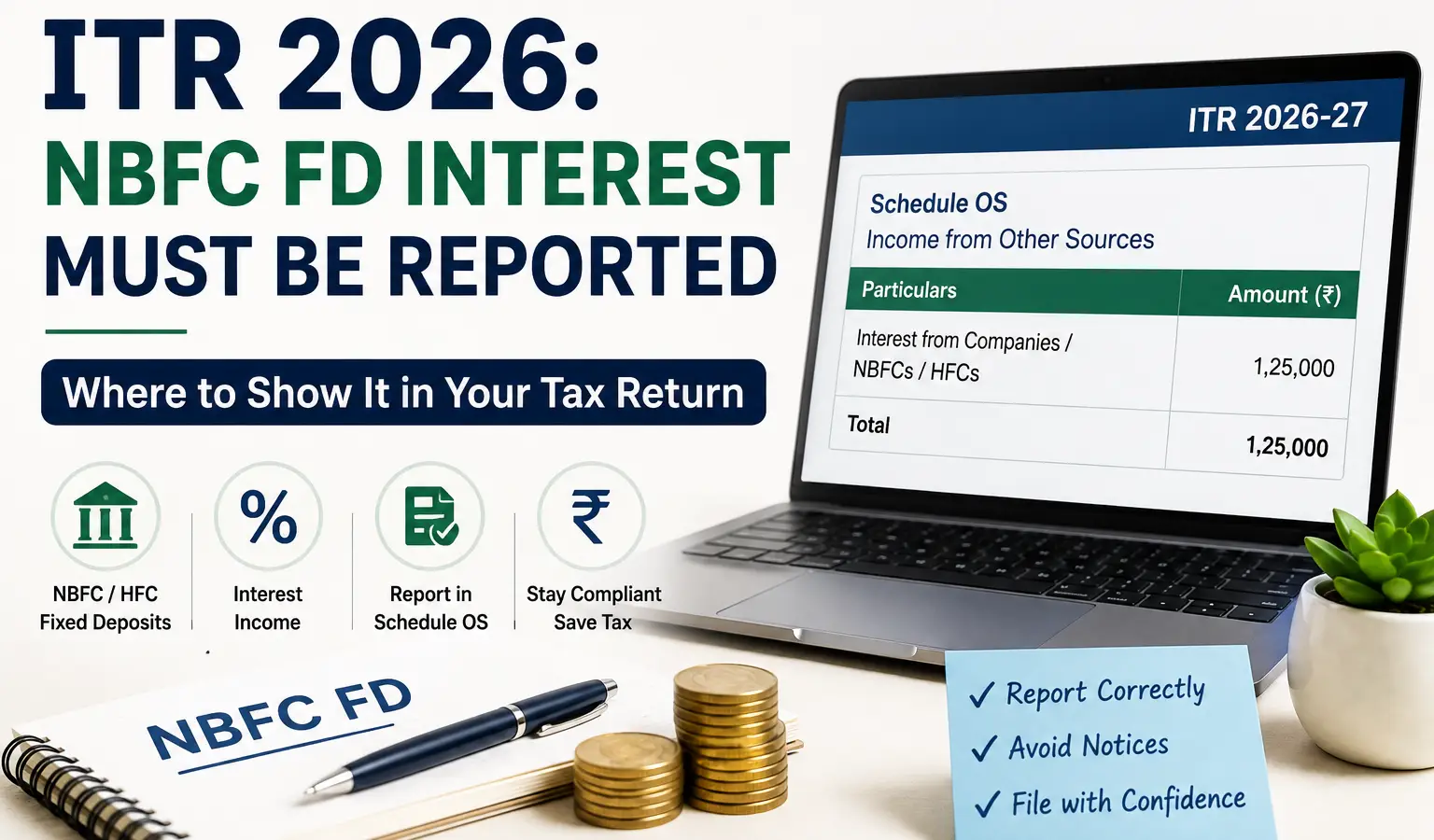
The revised ITR forms now specifically identify interest earned from companies, Non-Banking Financial Companies (NBFCs) and Housing Finance Companies (HFCs) under the “Others” category of Schedule OS — Income from Other Sources.
This does not mean that a new tax has suddenly been introduced on FD interest.
The key change is how the income is identified and reported in the return.
What Changed in ITR Forms for 2026?
The Income Tax Department has revised the ITR forms for AY 2026–27.
One notable clarification concerns interest earned from investments such as:
- Company fixed deposits
- NBFC fixed deposits
- HFC fixed deposits
- Certain corporate debentures
- Other qualifying interest-bearing instruments
The revised forms specifically identify interest from companies, NBFCs and HFCs under the “Others” category in Schedule OS.
This removes some of the ambiguity that existed in earlier forms about where such interest income should be classified.
Is NBFC Fixed Deposit Interest Taxable?
Yes, generally.
Interest earned from an NBFC or corporate fixed deposit is generally taxable as income from other sources when it is not part of a business of money lending.
The revised ITR forms do not create a completely new tax on this income. Instead, they make the reporting requirement more explicit.
For an individual taxpayer, the applicable tax treatment depends on the taxpayer’s total taxable income, tax regime and other applicable provisions.
So, don’t confuse:
New reporting requirement
with
New tax rate.
They are not the same thing.
Where Should NBFC FD Interest Be Reported in ITR 2026?
For the relevant ITR forms, the revised structure places interest from companies, NBFCs and HFCs under the “Others” category of Schedule OS — Income from Other Sources.
The relevant forms include:
- ITR-2
- ITR-3
- ITR-5
- ITR-7
The exact ITR form you need depends on your income sources and taxpayer category.
The Income Tax Department’s filing system currently provides AY 2026–27 return forms and utilities.
Example: You Earned ₹80,000 From an NBFC Fixed Deposit
Suppose you invested in a fixed deposit during FY 2025–26 and earned:
Interest income = ₹80,000
This ₹80,000 is income that needs to be considered while calculating your taxable income.
Under the revised ITR structure, qualifying interest from an NBFC, HFC or company is identified under the relevant “Others” category of Schedule OS.
The important point is that you should not ignore the interest simply because tax was already deducted from it.
TDS and reporting are two separate things.
Does TDS Mean You Don’t Need to Report the Interest?
No.
This is one of the most important points for FD investors.
Suppose:
FD interest: ₹80,000
TDS deducted: ₹8,000
The ₹80,000 is still the underlying income.
The TDS is tax that has already been deducted and can be considered while determining your final tax liability, subject to the applicable rules and records.
Therefore:
TDS deducted does not mean the income itself should be left out of your ITR.
Before filing, taxpayers should reconcile their interest income and tax deducted with their available tax records.
The Income Tax Department provides taxpayers access to Form 26AS and AIS through the e-Filing portal.
What Is Schedule OS?
Schedule OS stands for Income from Other Sources.
It is used to report income that generally falls under the “Other Sources” head rather than salary, house property, capital gains or business/profession income.
Interest income is one of the common types of income reported under this head.
The revised ITR forms provide more specific identification for interest from companies, NBFCs and HFCs.
Why Is This Change Important for FD Investors?
Many people think only bank FD interest matters when filing an ITR.
But investors can also earn interest from:
- Corporate deposits
- NBFC deposits
- HFC deposits
- Debentures
- Bonds
- Other fixed-income investments
The revised forms make the reporting treatment for certain company, NBFC and HFC interest more explicit.
This is particularly relevant for investors who prefer higher-yield fixed-income products and may have multiple interest-income sources.
What If You Have Multiple Fixed Deposits?
This is where taxpayers should be careful.
Imagine you have:
| Investment | Interest |
|---|---|
| Bank FD | ₹40,000 |
| NBFC FD | ₹60,000 |
| Corporate deposit | ₹35,000 |
| Other interest | ₹15,000 |
| Total | ₹1,50,000 |
You should not look at only one FD while preparing your return.
Your overall interest income needs to be reviewed according to the applicable tax rules and return form.
A common mistake is checking only bank statements while ignoring other fixed-income investments.
Check Your AIS Before Filing
The Annual Information Statement (AIS) can help taxpayers review information reported to the tax department.
Before filing your return:
- Log in to the Income Tax e-Filing portal.
- Review your AIS.
- Check your TDS information.
- Compare it with your bank and investment records.
- Identify any missing or incorrect information.
- Report the applicable income correctly in your ITR.
The Income Tax Department provides access to Form 26AS and AIS through the e-Filing portal.
What Happens If You Don’t Report the Interest?
Ignoring interest income because it is relatively small can create unnecessary tax complications.
For example, you might receive:
₹25,000 interest
and think that the amount is too small to matter.
But if the income is taxable and reportable, it should be included according to the applicable rules.
Also remember that the tax department can receive information about financial transactions through reporting mechanisms.
Therefore, it is better to reconcile your income records before submitting the return.
Is the Tax Rate on NBFC FD Interest Different?
The revised reporting requirement itself does not create a separate special tax rate simply because the interest comes from an NBFC or HFC.
The tax treatment depends on the applicable provisions and the taxpayer’s circumstances.
For many individual taxpayers, interest income is considered along with other taxable income when determining the final tax liability.
Therefore, investors should not assume:
“NBFC FD interest has a special tax rate.”
The important change discussed here is disclosure and classification in the ITR.
Who Should Pay Extra Attention to This Change?
This update is particularly relevant to:
1. Fixed Deposit Investors
Anyone who earned interest from non-bank fixed-income products should review their records.
2. Retired Investors
People depending on fixed deposits for regular income may have multiple deposits across different institutions.
3. High-Income Taxpayers
Higher total income can affect the final tax payable on interest income.
4. Investors With Multiple Interest Sources
Combining bank interest, corporate deposits, bonds and other investments can make reconciliation more important.
5. Taxpayers Filing ITR-2 or ITR-3
The revised reporting structure is particularly relevant to taxpayers using these forms where applicable.
ITR 2026: 5 Things Every FD Investor Should Check
Before submitting your return, check:
1. Total interest earned
Don’t look at only one FD.
2. TDS deducted
Verify the amount against your tax records.
3. AIS
Check the information available in your AIS.
4. Correct ITR form
Make sure your income sources match the form you are filing.
5. Schedule OS
Review the relevant income-from-other-sources reporting carefully.
Does This Apply to Bank FD Interest Too?
Bank FD interest is already a familiar category of taxable interest income.
The notable point in the AY 2026–27 revised forms is the more explicit identification of interest from companies, NBFCs and HFCs under the “Others” category of Schedule OS.
So the change should not be understood as saying that bank FD interest has suddenly become taxable.
Instead, it brings additional clarity to the reporting of certain non-bank and corporate interest income.
ITR 2026: The Bigger Lesson for Investors
The most important lesson is simple:
Don’t look at TDS alone.
Your tax return is about reporting your income correctly and then giving credit for eligible taxes already deducted or paid.
If you have several investments, your financial records should ideally show:
Investment → Interest earned → TDS → AIS/26AS → ITR
Keeping this chain accurate can make tax filing much easier.
Key Takeaways
- The AY 2026–27 ITR forms have revised reporting for certain interest income.
- Interest from companies, NBFCs and HFCs is specifically identified under the “Others” category of Schedule OS in relevant ITR forms.
- The relevant forms include ITR-2, ITR-3, ITR-5 and ITR-7.
- This is primarily a reporting clarification, not a new special tax on NBFC FD interest.
- TDS deduction does not remove the need to report the underlying income.
- Investors should reconcile interest income with AIS, Form 26AS and their own records.
- The applicable ITR form depends on the taxpayer’s overall income and circumstances.
Frequently Asked Questions
Is NBFC FD interest taxable in ITR 2026?
Generally, interest from an NBFC fixed deposit is taxable as income from other sources, subject to the applicable tax provisions and the taxpayer’s circumstances.
Where should NBFC FD interest be reported in ITR 2026?
For the relevant ITR forms, interest from companies, NBFCs and HFCs is specifically identified under the “Others” category of Schedule OS.
Does TDS mean I don’t need to report FD interest?
No. TDS and income reporting are different. The underlying interest income should still be reported as applicable, with eligible TDS considered while calculating the final tax liability.
Which ITR forms include the new NBFC and HFC interest reporting?
The revised reporting applies to relevant versions of ITR-2, ITR-3, ITR-5 and ITR-7.
Can I check my FD interest in AIS?
You can review tax-related information available through AIS and Form 26AS on the Income Tax e-Filing portal.
Is this a new tax on NBFC fixed deposits?
The change discussed here is primarily about explicit reporting/classification in the revised ITR forms, not the introduction of a separate tax solely because the deposit is with an NBFC or HFC.
Do bank FD and NBFC FD interest need to be considered separately?
They can have different reporting labels in the return structure, but both types of taxable interest need to be considered when determining your overall tax position.
Final Takeaway
If you earned interest from a company, NBFC or HFC fixed deposit during FY 2025–26, don’t overlook it while filing your AY 2026–27 Income Tax Return.
The revised ITR forms make the reporting of such interest more explicit under Schedule OS.
The practical approach is simple:
Check your interest → verify TDS → compare AIS/26AS → select the correct ITR → report the income correctly.
The change is less about introducing a new tax and more about making sure taxpayers clearly disclose income that is already relevant to their tax return.
For FD investors, the message is simple: TDS is not the end of the story. Your interest income still needs to be reported correctly.
Editorial note: This article is for educational purposes and is based on information available as of 25 August 2026. Tax treatment depends on individual circumstances and applicable law. Verify your return requirements on the official Income Tax e-Filing portal or consult a qualified tax professional where necessary.