Published: August 28, 2026
Category: Finance News
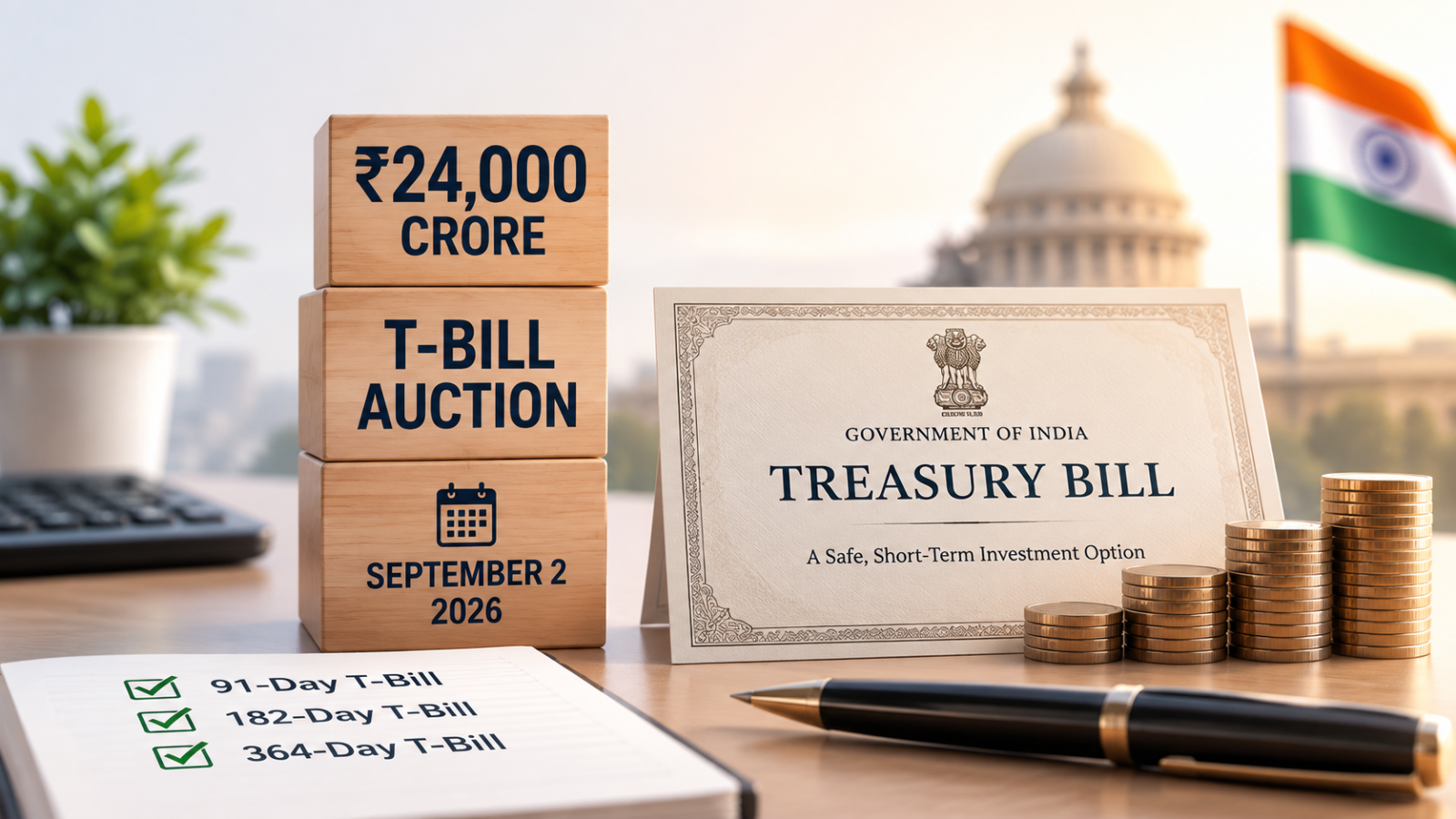
The Government of India is set to auction ₹24,000 crore worth of Treasury Bills (T-Bills) on September 2, 2026, giving investors another opportunity to participate in short-term government securities.
The auction will cover three Treasury Bill maturities — 91 days, 182 days and 364 days. Retail investors can also participate through the non-competitive bidding route, subject to applicable rules and allocation limits.
What Is the ₹24,000 Crore T-Bill Auction?
Treasury Bills, commonly known as T-Bills, are short-term government securities issued to meet the government’s short-term funding requirements.
For the September 2 auction, the notified amount is:
| Treasury Bill | Amount |
|---|---|
| 91-day T-Bill | ₹9,000 crore |
| 182-day T-Bill | ₹8,000 crore |
| 364-day T-Bill | ₹7,000 crore |
| Total | ₹24,000 crore |
The auction is part of the Government of India’s scheduled Treasury Bill issuance programme.
Can Retail Investors Participate in the T-Bill Auction?
Yes.
Eligible individual investors can participate in Treasury Bill auctions through the non-competitive bidding mechanism.
Under this route, retail investors do not have to compete by quoting a specific price or yield in the same way as competitive bidders.
Retail participation is subject to the applicable allocation framework. The retail allocation is capped at 5% of the notified amount.
This means individual investors can participate, but submitting a bid does not necessarily guarantee the exact amount requested.
When Is the September 2026 T-Bill Auction?
The important dates are:
Auction date: September 2, 2026
Settlement date: September 3, 2026
The scheduled bidding window for non-competitive bids is between 10:30 AM and 11:00 AM on the auction date.
Investors should check the latest official auction information before placing a bid because auction procedures and operational details can change.
What Are the Three T-Bill Options?
91-Day Treasury Bill
The government has notified ₹9,000 crore for the 91-day Treasury Bill.
This is the shortest maturity available in this auction and may suit investors looking for a relatively short investment period.
182-Day Treasury Bill
The 182-day Treasury Bill has a notified amount of ₹8,000 crore.
It provides a medium-term option compared with the 91-day security.
364-Day Treasury Bill
The longest maturity is the 364-day Treasury Bill, with ₹7,000 crore notified for the auction.
Investors choosing this option should consider whether they are comfortable keeping their money invested for almost a year.
How Do Treasury Bills Generate Returns?
Treasury Bills generally do not work like conventional fixed deposits that pay periodic interest.
They are normally issued at a discount to their face value and redeemed at face value at maturity.
For example, a T-Bill with a face value of ₹100 may be purchased for less than ₹100 and redeemed at ₹100 on maturity.
The difference between the purchase price and the redemption value represents the investor’s return.
The actual return depends on the price and yield determined through the auction.
Are Treasury Bills Safe?
Treasury Bills are short-term government securities and are backed by the Government of India.
However, investors should not interpret this as meaning that every aspect of the investment is completely risk-free.
If an investor holds a T-Bill until maturity, the security is redeemed according to its terms.
But if an investor wants to sell a government security before maturity, its market price can change depending on prevailing interest rates and market conditions.
Therefore, investors should understand the difference between holding until maturity and selling before maturity.
How Can Retail Investors Participate?
Eligible individual investors can use the RBI’s Retail Direct mechanism to participate in government securities, including Treasury Bills.
The non-competitive route is designed to make participation easier because investors do not need to compete directly by specifying the auction price or yield.
Before placing an order, investors should check:
- Eligibility requirements
- Available investment amount
- Bidding window
- Settlement requirements
- Maturity period
- Tax implications
Investors should also review the latest official auction information before submitting a bid.
Does Every Retail Investor Get an Allocation?
Not necessarily.
Retail participation is subject to the applicable allocation framework.
The retail portion is capped at 5% of the notified amount.
Therefore, investors should not assume that placing an application automatically guarantees the full amount requested.
What Should Investors Check Before Investing?
Before participating in the T-Bill auction on September 2, 2026, consider these five points.
1. Investment Horizon
Choose a maturity that matches when you may need the money.
2. Expected Yield
The final return depends on the auction price and resulting yield.
Previous auction yields can be used as a reference, but they do not guarantee the yield of the September 2 auction.
3. Liquidity
If you may need the money before maturity, understand that selling before maturity can expose you to market-price movements.
4. Tax Treatment
Treasury Bill returns can have tax implications. Investors should consider their individual tax position rather than assuming that the return is tax-free.
5. Overall Financial Plan
Treasury Bills can be one part of a broader financial plan. Investors should consider their overall financial goals before committing money.
T-Bills vs Fixed Deposits
Treasury Bills and fixed deposits are different financial products.
| Feature | Treasury Bills | Fixed Deposits |
|---|---|---|
| Issuer | Government of India | Bank |
| Return structure | Discount and redemption | Interest-based |
| Maturity | Short term | Various tenures |
| Return | Depends on purchase price/yield | Based on deposit terms |
| Market price | Can change before maturity | Not normally market-priced |
| Early exit | Market conditions may matter | Subject to deposit terms |
The appropriate option depends on an investor’s objectives, liquidity requirements, tax position and risk preferences.
Why Does the ₹24,000 Crore Auction Matter?
The September 2 auction is part of the government’s scheduled Treasury Bill issuance programme.
For retail investors, the important point is that individual investors have a mechanism to participate in government securities auctions.
This makes Treasury Bills worth understanding for people looking for short-duration fixed-income investments.
The three maturities also give investors different time horizons to consider.
5 Things to Remember Before the September 2 Auction
1. Check the maturity
Choose between 91, 182 and 364 days based on your financial needs.
2. Don’t assume the yield
The final yield is determined through the auction.
3. Understand non-competitive bidding
Retail investors participate through the non-competitive route, subject to applicable rules.
4. Consider taxes
Understand how the investment return will affect your individual tax position.
5. Don’t invest only because the security is government-backed
Your investment should still fit your liquidity requirements and overall financial plan.
Key Takeaways
- The T-Bill auction on September 2, 2026 has a total notified amount of ₹24,000 crore.
- The auction includes 91-day, 182-day and 364-day Treasury Bills.
- The notified amounts are ₹9,000 crore, ₹8,000 crore and ₹7,000 crore respectively.
- Eligible retail investors can participate through the non-competitive bidding route.
- Retail allocation is subject to the applicable limit.
- The scheduled settlement date is September 3, 2026.
- The final auction yield cannot be known in advance.
- Previous yields should not be treated as guaranteed future returns.
- Investors should consider maturity, liquidity and tax implications before investing.
Frequently Asked Questions
What is the T-Bill auction on September 2, 2026?
It is a Government of India Treasury Bill auction with a total notified amount of ₹24,000 crore, divided across 91-day, 182-day and 364-day securities.
Can retail investors participate in the September 2 T-Bill auction?
Yes. Eligible individual investors can participate through the non-competitive bidding mechanism, subject to applicable rules and allocation limits.
How much is the September 2 T-Bill auction worth?
The total notified amount is ₹24,000 crore.
What are the T-Bill maturities?
The auction includes 91-day, 182-day and 364-day Treasury Bills.
When is the settlement date?
The scheduled settlement date is September 3, 2026.
How do Treasury Bills generate returns?
Treasury Bills are generally issued below their face value and redeemed at face value at maturity. The difference represents the investor’s return.
Are Treasury Bills completely risk-free?
Treasury Bills are sovereign government securities, but investors should still consider liquidity, interest-rate movements, tax treatment and their investment horizon.
Do Treasury Bills pay regular interest?
Generally, no. T-Bills are normally issued at a discount rather than paying periodic interest like a conventional fixed deposit.
Can I sell a Treasury Bill before maturity?
Government securities can be traded before maturity, but their market price can change. Investors selling before maturity should understand the possibility of a gain or loss based on market conditions.
Final Takeaway
The ₹24,000 crore T-Bill auction on September 2, 2026 gives eligible retail investors another opportunity to participate in India’s government securities market.
With 91-day, 182-day and 364-day maturities available, investors have different time horizons to consider.
However, the right choice depends on individual financial goals, liquidity requirements, expected returns and tax considerations.
Government backing alone should not be the only reason to invest.
Before participating, investors should review the latest official auction details and make sure the investment fits their financial plan.
This article is for educational and informational purposes only and does not constitute investment, financial or tax advice. Treasury Bill yields can change, and past auction yields do not guarantee future returns. Investors should review the latest official information before making an investment decision.